
How to get a cottage food permit in Washington and sell food from your home kitchen
Washington lets you bake and sell from your own kitchen with one state permit. What you can make, the $35,000 cap, the $355 fee, the label rules and where you can sell.
- Application fee
- $355
- Yearly sales cap
- $35,000
- Products allowed
- 50
The short answer
Apply to the Washington State Department of Agriculture (WSDA). The application costs $355, a kitchen inspection follows, and processing takes about 6 to 8 weeks. You can sell low-risk foods such as breads, cookies, candy and jams straight to customers, up to $35,000 in gross sales a year, but you cannot ship them.
What changed
- Nov 11, 2026First published
Plenty of food businesses in our communities start the same way: a cake for a cousin’s wedding, then the neighbours, then a table at the market. In Washington you can do that legally from your own kitchen with a cottage food permit from the Washington State Department of Agriculture (WSDA). This guide covers what you can sell, what it costs, the inspection, the label and where you can sell. Everything was checked against WSDA’s own page on 11 November 2026 (WSDA).
What you can make
Only low-risk foods that do not need a fridge to stay safe are allowed. WSDA’s list includes:
- Baked or fried goods made in an oven, on the stovetop or in an electric cooker: breads, cakes, cookies, bars, crackers, granola and most pies.
- Candy made on the stovetop or in the microwave. You must use a candy thermometer.
- Standard jams, jellies, preserves and fruit butters that meet the federal recipe standard.
- Dry herb blends, seasonings, teas and mixes made from approved ingredients.
- Coffee roasted in small batches on a countertop roaster, and vanilla extract.
What you cannot make
Anything that needs refrigeration or carries a higher risk is out. That means meat, poultry and fish (including jerky), canned or pickled vegetables, dairy, cut fresh produce, refrigerated cakes and fillings, juices and other drinks, barbecue sauce, ketchup, mustard, low-sugar jams and pet treats (WSDA). For most cooked dishes, from jollof to oxtail, you need a licensed kitchen instead; see the last section.
What it costs and the limits
- $355 to apply, not refundable once WSDA receives it.
- $125 for a re-inspection if you fail the first one. Fail twice and the application is denied.
- $105 to change your permit between renewals; adding a single product by addendum is $30 plus a $75 public health review fee.
- $35,000 in gross sales a year at most. If you go over, the rule says you must stop for the rest of the permit period or get a food processing plant licence (WAC 16-149-040).
- 50 master products at most. Flavours of the same cookie count as one.
The permit belongs to you and your home. If you move, you apply again and pay again. WSDA’s page gives the length as two years in one place and one year in another, so confirm it when you apply.
How to apply
- Get a Washington business licence through the Department of Revenue, which WSDA asks for with the application. Our guide to the Seattle business licence explains both licences.
- Get a food worker card for everyone who will work in the kitchen, through your county health department, not a third-party website.
- Fill in the cottage food application packet from the WSDA site. Do not send recipes: applications can be released under public records law.
- Send the $355 fee, your product labels (a blank “Permit #:___” is fine at this stage), the signed food worker cards and your business licence.
- A WSDA food safety specialist reviews it, then you schedule and pass a kitchen inspection. Allow about 6 to 8 weeks from a complete application.
What the inspector looks for
The kitchen must be in your main home, with surfaces that are smooth and easy to clean. Rugs and carpet are not allowed in the kitchen, though cleanable mats are. You do not need a three-compartment sink or a separate fridge, but you need a tub to act as a third sink, or a dishwasher. Ingredients and products must be stored inside the house, not in a garage, shed or barn, and children under six are kept out of the production area; if they are at home, you need a written plan for them (WSDA).
What goes on the label
- Your business name and permit number.
- The product name.
- Ingredients in order of weight, with allergens named (say which tree nut).
- Net weight or volume.
- In capitals: “MADE IN A HOME KITCHEN THAT HAS NOT BEEN SUBJECT TO STANDARD INSPECTION CRITERIA”.
For a wedding cake or other large order, an ingredient sheet handed over with the cake can stand in for a label.
Where you can sell
You can sell only directly to the person who will eat it: from your home, at farmers markets, craft fairs and other public events. You can advertise online and take orders online. You cannot ship by post or courier, sell wholesale or on consignment, sell through shops or restaurants, or sell outside Washington. Payment and handover must be in person.
When you outgrow your kitchen
If you want to cook meat dishes, sell to shops, ship orders or go past $35,000, you move to a licensed kitchen: a WSDA food processor licence for packaged food, or a county food permit for a restaurant, caterer or food truck (see our food truck guide). Free advice and money to make that jump:
Deadline
Rolling
Washington SBDC: free one-to-one business advising
Washington Small Business Development Center · Free
Free one-to-one advising on pricing, costs and the move to a commercial kitchen.
Deadline
Rolling
Denkyem Co-op loans for Black-owned businesses: $10,000–$100,000
Denkyem Co-op · $10,000–$100,000
Loans from $10,000 for Black-owned businesses ready to grow.
Nov17Tue
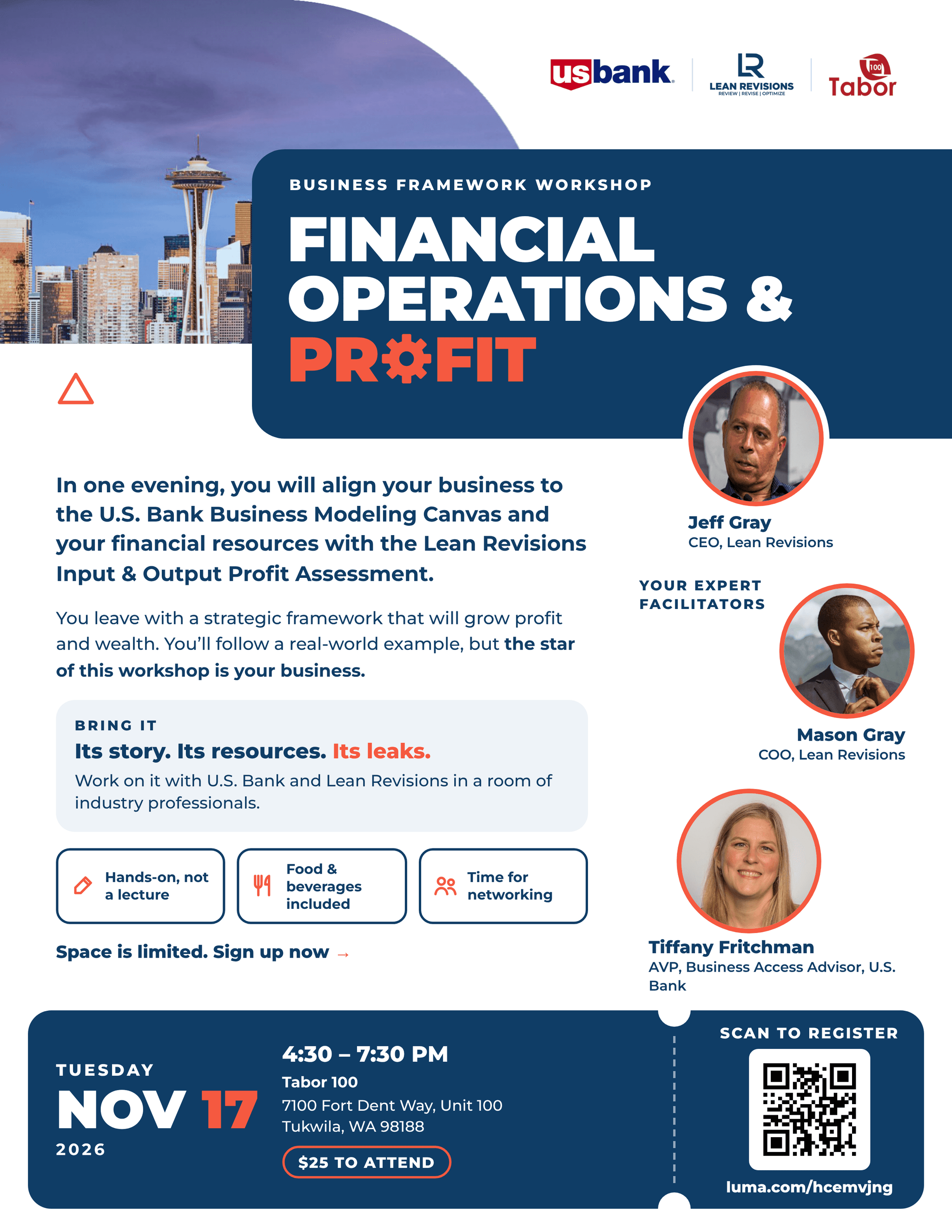
Financial Operations & Profit Workshop
Took place, Tabor 100 Business Center, Tukwila. $25 to attend
A Tabor 100 workshop on the money side of a small business.
More money and help: grants, loans and free help for Black and immigrant business owners.
Sources
WSDA Cottage Food Operation, WAC 16-149-040, Department of Revenue: apply for a business licence. WSDA answers questions on (360) 902-1876 or [email protected].
Questions people ask
- Can I sell home-cooked meals in Washington?
- Not under a cottage food permit. Meat, fish, dairy and other foods that need refrigeration are not allowed. Cooked meals need a licensed kitchen and a county food permit.
- Can I sell cottage food online?
- You can advertise and take orders online, but you cannot ship. The customer must pay and collect in person.
- How much does a cottage food permit cost?
- The application is $355. A re-inspection, if needed, is $125.
- Can I sell my cottage food to a shop or café?
- No. Cottage food can only be sold directly to the end customer, not wholesale, on consignment or through shops and restaurants.
#cottage food permit washington#sell food from home washington#home bakery license washington#wsda cottage food
Know a business we should feature?
Tell us who, and why. Pitch a story or nominate a business.
Keep reading

Running a business
Finding an accountant, bookkeeper or tax preparer you can trust in Seattle and South King County
Who is allowed to prepare your taxes, how to check a CPA or enrolled agent in two minutes, and the accounting and bookkeeping firms in the Ujima directory.
Ujima Network team, November 13, 2026. 4 min read

Running a business
Black business networks and chambers in Seattle: Tabor 100, BOBE, the African Chamber and more
Seven groups where Black and African business owners in Greater Seattle meet, learn and find contracts, with what each costs, where it meets and what is on in the next month.
Ujima Network team, November 13, 2026. 5 min read
Running a business
How to find a Black lawyer in Seattle: the Loren Miller Bar Association, referrals and free clinics
Where to look for a Black attorney in Seattle and King County, how the bar’s referral line and free clinics work, and what to check before you hire anyone.
Ujima Network team, November 13, 2026. 5 min read
The Village