Redlining and racial covenants in Seattle: how to look up your own street
More than 37,000 King County properties carried deeds that barred people by race. How covenants and redlining worked, how to search the map, and how to strike one from your deed for free.
- Restricted subdivisions mapped
- 620
- County fee to record a modification
- $0
The short answer
The University of Washington’s Racial Restrictive Covenants Project has found racial restrictions on more than 37,000 King County properties in 620 subdivisions. Search its map by address. Covenants have been void in Washington since 1969; an owner can strike one by recording a free modification form.
What changed
- Nov 13, 2026First published
If your home in King County was built before the 1960s, its paperwork may once have said who was allowed to live there. Seattle was, in the words of the University of Washington’s civil rights history project, “a sharply segregated city” for most of its history (UW). Two tools did much of that work: racial covenants and redlining. This guide explains both, shows you how to look up your own street, and sets out what you can do about a covenant on your deed. It is general information, not legal advice. Checked 13 November 2026.
What a racial covenant was
A racial covenant was a clause written into a deed or a subdivision’s rules that barred people of named races from buying, renting or living on the property. The earliest one the UW project has found in Washington dates from 1907, and they became much more common after 1926, when a Supreme Court decision made them enforceable contracts that bound later owners: a sale that broke one could be reversed and the new owner evicted (UW).
The wording used the labels of the day. “Ethiopians” meant people of African ancestry, “Malays” meant Filipinos, “Mongolians” meant East Asians, “Hindus” meant South Asians and “Hebrews” meant Jews. Subdivisions laid out between 1925 and 1948 were the most likely to be restricted, and older neighbourhoods including Capitol Hill, Madison Park, Queen Anne, Magnolia and parts of Madrona were restricted by petition drives that added clauses to existing homes (UW).
What redlining was
Redlining worked through lenders. In the 1930s the federal Home Owners’ Loan Corporation drew “residential security” maps of American cities, grading neighbourhoods from A, “best” and coloured green, to D, “hazardous” and coloured red. On Seattle’s 1936 map the Central District was graded hazardous, and its whole description was one sentence: “This is a negro area of Seattle.” Mortgages and investment went elsewhere. A 1975 report by the Central Seattle Community Council Federation found that for every dollar deposited in Central District banks, 25 cents came back to the area in loans (The Urbanist, an opinion piece, June 2026).
How to look up your street
The Racial Restrictive Covenants Project, run by the University of Washington and Eastern Washington University, has searched more than seven million property records and identified more than 80,000 restricted properties across the state (UW). To use it:
- Open the project’s King County page. It links to an interactive map of more than 37,000 restricted properties in 620 subdivisions.
- Use “Search by address” and zoom in. The map shows the exact parcels and the wording of the restriction.
- On the project’s overview map, red marks subdivisions where the project has found the documents, and yellow marks places advertised as “restricted” where it has not yet found full proof (UW).
- Open the restricted subdivisions list to read the language, see the developer’s name and download the original documents.
- Outside King County, the project has pages for Pierce, Snohomish, Thurston, Kitsap and other counties (UW).
A blank on the map is not a clean bill of health. The project says its research is unfinished, and that some neighbourhoods without covenants kept people out by other means (UW).
If your deed has a covenant
Nobody can enforce it. The US Supreme Court ruled in 1948 that covenants could not be enforced, the federal Fair Housing Act banned them in 1968, and a 1969 Washington law made them void. The project says you do not need to file anything to protect your rights. But since 2018 Washington law has let owners formally strike the words, and it is free apart from the notary (UW):
- From your deed or title insurance policy, note the recording number and date of the document that contains the covenant, the names of all current owners, the legal description and the tax parcel number.
- Fill in the “Restrictive Covenant Modification” form, but do not sign it yet. King County has one form for individuals and one for organisations.
- Sign it in front of a notary, with photo ID. The notary may charge.
- Record it with the county, in person or by post. In King County that is the Recorder’s Office, 201 S Jackson Street, Suite 204, Seattle; phone 206-477-6620. Recording is free (King County).
The modification puts a notice in the land records that the covenant is void and strikes it legally. It does not erase the historic document (UW). If your situation is complicated, ask a lawyer or a housing counsellor.
Why it still matters
In 2022, 62% of White families in King County owned their home, compared with 28% of Black families (UW). The Legislature has changed state law four times in response to the project’s findings, most recently with the Covenant Homeownership Account Act of April 2023, meant to compensate families harmed by these practices (UW). If you are buying now, start with our first-time homebuyer guide.
Keeping a home in the family is the other half of the story. Black Legacy Homeowners meets every month:
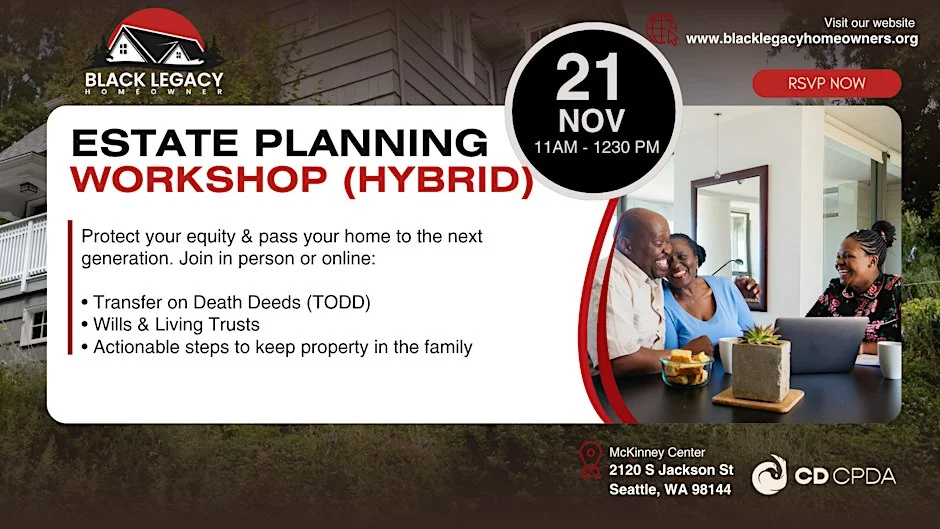
Nov21Sat
Estate planning essentials: keep your home in the family
Took place, McKinney Center, Room 111L, Seattle. Free · register on Eventbrite
A free workshop on passing a home to your family without probate.
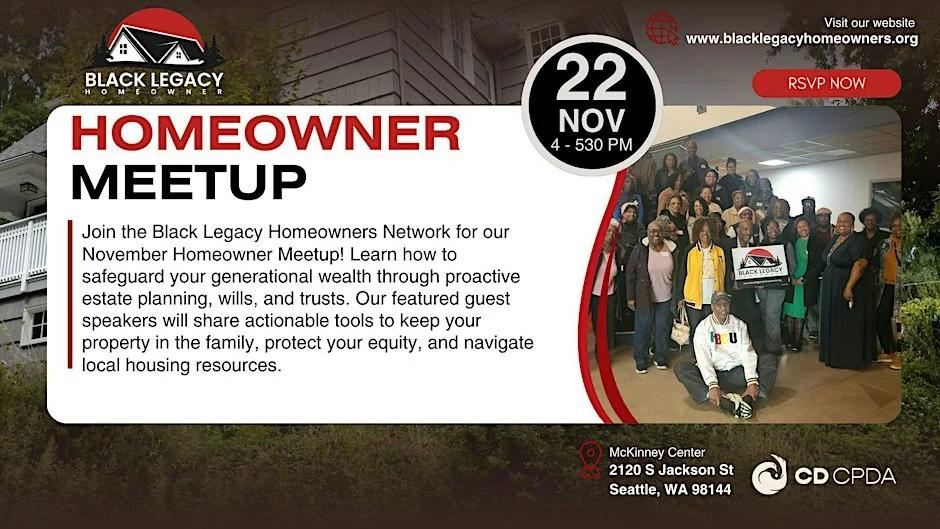
Nov22Sun
Black Legacy Homeowners monthly meetup
Took place, McKinney Center for Community & Economic Development, Seattle. Free, RSVP on Eventbrite
The monthly meetup: neighbours, resources and keeping homes in the family.
For the history on the ground, read our guides to the Central District and Rainier Valley. Renters can start with tenant rights in Seattle, and more help is on /resources.
Sources
UW Racial Restrictive Covenants Project: about, King County restrictions and how to file a covenant modification; Seattle Civil Rights and Labor History Project: Segregated Seattle and covenants map; King County Recorder’s Office: how to prepare and record a modification; The Urbanist: How Redlining Housing Discrimination Continues to Impact Seattle Today, an opinion piece by Elijah Wright (June 2026). Checked 13 November 2026.
Questions people ask
- How do I find out if my house had a racial covenant?
- Search your address on the interactive King County map of the University of Washington’s Racial Restrictive Covenants Project. It shows restricted parcels and the wording used. The project also covers Pierce, Snohomish and other counties.
- Are racial covenants still legal in Washington?
- No. They cannot be enforced. The UW project says they have been void in Washington since 1969, and state law makes it an unfair practice to try to honour one.
- How do I remove a racial covenant from my deed?
- Fill in a Restrictive Covenant Modification form, sign it before a notary and record it with your county. In King County recording is free at the Recorder’s Office, 201 S Jackson Street, Suite 204.
- Was the Central District redlined?
- Yes. On the federal Home Owners’ Loan Corporation’s 1936 map of Seattle the Central District was graded “hazardous”, the lowest grade.
- Which Seattle neighbourhoods had covenants?
- Hundreds. The UW project names Capitol Hill, Madison Park, Queen Anne, Magnolia and parts of Madrona among older areas restricted by petition, plus many subdivisions laid out between 1925 and 1948.
#racial covenants seattle#redlining seattle map#racial restrictive covenants king county#remove racial covenant washington#seattle segregation history
Know a business we should feature?
Tell us who, and why. Pitch a story or nominate a business.
Keep reading

Heritage
The Black miners of Roslyn: how a coal strike brought hundreds of Black families to the Cascades
In 1888 a railway company brought Black miners to Roslyn to break a strike. By 1900 they were a fifth of the town. Their story, and what to see there today.
Ujima Network team, November 13, 2026. 5 min read

Heritage
The Seattle Black Panther Party: a short history, and the places that still carry it
Seattle had the first Black Panther chapter outside California. Its free clinic is still open on Yesler Way, and its memorial mural became a city landmark in 2026.
Ujima Network team, November 13, 2026. 5 min read

Heritage
Buffalo Soldiers at Fort Lawton: the regiment that was a third of Black Seattle, and what remains
In 1909, 900 Black soldiers arrived at Fort Lawton in what is now Discovery Park. Their band barracks still stands, and a Tacoma museum hopes to move in.
Ujima Network team, November 13, 2026. 4 min read
The Village